It All Begins Here - Camellia Sinensis
Have you ever wondered where your tea comes from? Did you know that all true tea comes from ONE plant! The Camellia Sinensis plant! One of many things that makes tea so interesting is that the only thing that differentiates all the tea types - white, green, black, oolong, and pu’erh - is how the tea leaves are processed. It’s amazing to know that all tea coming from one source can have such a broad range of flavour and colour based on its nurturing process. Most of this ‘nurturing’ process involves oxidation of the leaves to allow for different chemical components to arise within the tea leaf, thus creating the flavour of your tea!
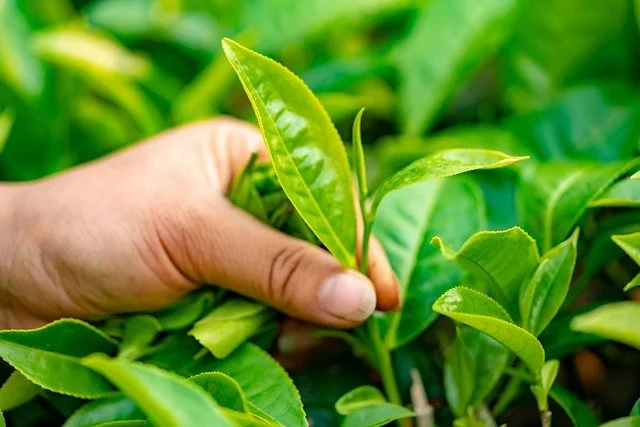
The Camellia sinensis plant is a super cute bush that has white flowers at the top. The leaves are serrated and are a gorgeous green colour. Most tea plants are kept at about 2 feet in growth to allow for easier harvesting with machines and through hand-plucked work, however, tea plants in the wild can continue to grow to be taller than the average female adult.
Openpix.art
To make it easier to harvest, tea is kept shorter and farmers will ‘pluck’ the first two or three leaves of the top of the plant, as well as the buds. This is where most of the energy of the plant shoots to and contain the most antioxidants and health benefits.
The baby buds and very top of the plant are harvested with the intention of becoming white tea. This part of the Camillia sinensis is the most delicate and so is its flavours. To keep the delicacy and preserve the integrity of the tea intended to be white tea, the plant is immediately dried without causing oxidation and then packaged. The flavours of white tea can be very light and delicate, with floral notes.
Black tea on the other hand is processed with the intention that it fully oxidizes. The tea is left out in the air to do this and the tannins within the tea increase, giving it that light to deep brown colour. This also greatly alters the flavour and creates a stronger and more bold flavour that can have different undertones depending on the region that the tea was processed in. Another interesting thing about black tea that changes the flavour is how its leaf size is determined. A larger, and more unprocessed leaf, has a lighter flavour compared to a black tea that has been crushed or torn into smaller pieces. The surface area differences of the tea within a cup help shape the flavour as well. So a larger leaf black tea, such as an English Breakfast, tastes different than a smaller leaf black tea, such as an Irish Breakfast. In this case, size matters!
Green tea also has different methods of processing to alter the flavour profile. Green tea is left out to oxidize briefly, but what really creates a difference of flavour is whether that green tea that has been briefly oxidized is pan-fired or steamed. Chinese green tea is pan-fired in large woks and has a smokier and smooth flavour, while Japanese green tea is steamed and therefore has a more seaweed-like and vegetative flavour.
Matcha, which is also processed as a green tea, has a really neat growing technique. These bushes intended to be matcha, are shaded under a dark cover and this boosts the chlorophyll in the plant, causing it to be a bright green colour. The leaves are then broken down finely into a powder, and you drink the powdered leaves whole after whisking them into water. Essentially, matcha is ground green tea leaves.
Oolong tea is also really interesting, as it has the broadest range of flavour profiling. Oolong tea is considered the tea ‘in between’ black and green teas due to its level of oxidation. These teas are left out to oxidize but then the process is strategically halted to create oolong teas at different variations of oxidation, and therefore different variations of flavour. To do this, the tea is either pan-fired or dried and can have flavours close to green teas at a low oxidation percent, vs oolong tea that tastes like a black tea due to higher percentages of oxidation. In my opinion, the best oolong teas are about 75%-80% oxidized and have a nutty and creamy flavour to them. Delicious!
Lastly, we have pu’erh tea, which is a highly fermented tea. In some cultures, these teas were buried in jars in the earth for long periods of time, sometimes years, to allow the microbial enzymes and fermentation to further occur. The result of this creates a very earthy and deeply rich tea flavour.
In the world of tea, the Camillia sinensis is the main plant - the root source. Just with one plant, the effects on how you nurture it, aka how you process it, show that it takes on a whole different look, flavour, and sometimes purpose for health benefits simply based on how it's treated. Perhaps this plant has more to teach the human race about how treating something a certain way, changes its nature.
References - Tea Association of Canada. (2022). Tea sommelier certification program curriculum. Tea Association of Canada.